
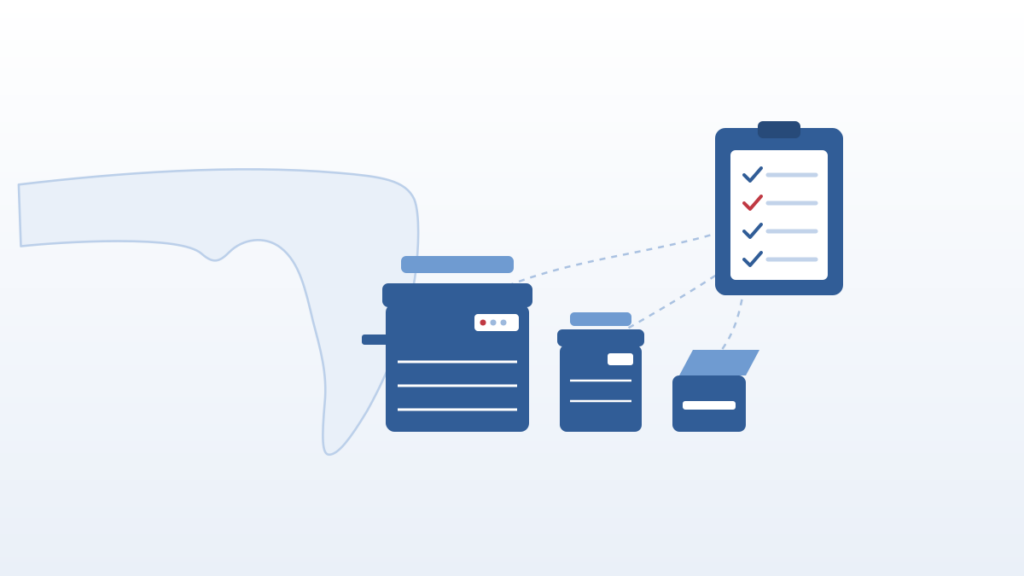
Quick answer: Before a Florida agency replaces a copier fleet, it should document the existing devices, actual print and scan volumes, required workflows, security controls, network dependencies, service history, lease dates, and procurement requirements. Do that before selecting Canon models or requesting final pricing. A clean baseline makes it easier to right-size the copier fleet, compare contract configurations, avoid unnecessary equipment, and issue a defensible purchase order.
A Florida contract can simplify copier fleet purchasing, but it cannot decide what your offices actually need. If the starting information is incomplete, an agency can still buy too many devices, choose the wrong mix of A3 and A4 machines, overlook an important scan workflow, or discover an end-of-term obligation after the replacement has already been ordered.
Here is the information worth assembling before a Florida public-sector copier fleet project moves from discussion to quotation.
Start with a location-by-location copier fleet inventory
Begin with what is installed today. Avoid relying on an old equipment schedule without walking the locations or confirming the information with the people who use the devices.
For every copier, multifunction printer, desktop printer, and document scanner, record:
- building, floor, department, and physical location;
- manufacturer, model, serial number, and asset number;
- whether the equipment is owned, leased, rented, or supplied under another arrangement;
- lease start date, scheduled end date, and known return or purchase requirements;
- current black-and-white and color meter readings;
- installed paper trays, finishers, fax boards, card readers, and other accessories;
- network address, print queues, address books, and embedded applications;
- service history and recurring problems; and
- the employee or department responsible for approving changes.
This copier fleet inventory can reveal issues that are invisible on an invoice. One device may have an unused accessory, while another department is hand-assembling packets because its machine lacks the right finishing option. A lightly used copier may have been abandoned after recurring problems.
Measure real activity, including peaks and scanning
Annual totals are useful, but averages can mislead. A department with seasonal or emergency peaks may need more capacity than its average month suggests.
For a defensible copier fleet baseline, collect at least 12 months of available meter history when possible. Separate black-and-white pages from color pages and note unusual peaks. Also document scanning activity, because a machine with modest print volume may still be essential as a high-use document-capture station.
Ask users about work the meters do not explain:
- Are large jobs sent to another floor because the local device is too slow?
- Are employees scanning documents one side at a time?
- Are oversized pages, bound materials, identification cards, checks, or fragile originals common?
- Are confidential jobs being left in the output tray?
- Does a department need stapled packets, booklets, hole punching, or 11-by-17-inch output?
- Do employees maintain local address books or one-touch scan buttons that must be rebuilt?
Map workflows before choosing hardware
Copier fleet replacement affects more than printing. Multifunction devices may scan to email, network folders, cloud repositories, case-management systems, and workflow software. Replacing hardware without mapping those connections can interrupt a business process even when the new device prints perfectly.
For each important copier fleet workflow, identify:
- who initiates it;
- what type of document is involved;
- where the document must go;
- what file format, naming convention, indexing, or quality setting is required;
- who owns the receiving system; and
- how the workflow will be tested before the old equipment is removed.
The Florida contract portfolio is broader than standard office copiers. Canon’s Florida participating addendum lists A3 and A4 multifunction devices, production equipment, single-function printers, large and wide-format equipment, scanners, software, consumables, managed print services, and maintenance among its covered categories. That does not mean every Canon product or configuration is currently available under contract. It does mean an agency should evaluate the complete document workflow rather than assume every requirement belongs on one departmental copier. Florida DMS Canon participating addendum
Write security requirements separately from product preferences
Do not treat “secure copier” as a sufficient specification. Define the actual controls the agency expects and determine which are required, optional, licensed separately, or dependent on other systems.
The copier fleet security worksheet should address questions such as:
- Must users authenticate before copying, scanning, or releasing print jobs?
- Will authentication use a card, PIN, username and password, or an identity provider?
- Are department codes, cost centers, quotas, or audit reports required?
- Which scan destinations are allowed?
- Who may change device settings, address books, firmware, and applications?
- How will administrator credentials be stored and transferred?
- What logging must be available, and who reviews it?
- What is the process for firmware updates, vulnerability notices, and configuration changes?
- What must happen to stored information when a device is returned, transferred, or retired?
Canon’s 2026 recognition from Keypoint Intelligence included A3 devices, A4 devices, and uniFLOW Online. Canon says the recognized portfolio included security offerings, remote device access, secure pull printing with multifactor authentication, and advanced scan workflows. Those capabilities are useful reasons to investigate a Canon configuration, but they should not be written into a specification as if they are included on every device. Confirm the exact hardware, software, subscription, identity, network, and licensing requirements. Canon’s 2026 Keypoint Intelligence awards announcement
Right-size the mix of A3, A4, scanners, and shared devices
A copier fleet rarely needs the same machine everywhere. A3 devices can handle ledger-size paper and are commonly chosen for more demanding departmental work, flexible paper handling, and finishing. A4 devices are generally smaller and can be a better fit where standard letter- and legal-size work dominates. Dedicated scanners may be better than an MFP for specialized capture volume, unusual originals, or continuous intake work.
Right-sizing can include:
- a capable A3 color MFP in a central administrative area;
- A4 devices closer to smaller workgroups;
- black-and-white equipment where color is unnecessary;
- a dedicated scanner for intake or records operations; and
- fewer personal printers where a properly placed shared device can meet the need.
Canon belongs on a serious A3 shortlist, but market position is not a substitute for analysis. A 2026 Canon flyer, using data attributed to the IDC U.S. Quarterly Hardcopy Peripherals Tracker for 2025, reports that Canon held 22% of the U.S. A3 laser MFP market and ranked first in the total, black-and-white, and color A3 segments. That is national market evidence—not Florida, government, NASPO, or ABS market share—and it does not prove that one model fits every agency.
The same restraint applies to awards. Canon received Keypoint Intelligence’s 2026 A3 Line of the Year recognition. Keypoint’s energy evaluation also found that ten tested Canon A3 models collectively used 18% less energy than the competing devices in that evaluation, while ten tested Canon A4 devices collectively used 47% less. Those are defined test-group results, not promised reductions in an agency’s utility bill or operating budget. Canon energy-efficiency award announcement
Compare total operating requirements, not only equipment price
A useful copier fleet comparison shows what the agency will operate and pay for over the expected term. Ask vendors to identify:
- each base unit and accessory;
- purchase, lease, or rental structure;
- included and excluded service items;
- black-and-white and color service rates;
- supplies included and excluded;
- estimated volumes and overage treatment;
- software and subscription charges;
- installation, network configuration, training, and removal responsibilities;
- meter-reporting requirements;
- escalation and service-communication procedures; and
- end-of-term notice, return, purchase, and data-removal responsibilities.
The lowest equipment price may not produce the lowest operating cost. Compare every option using the same copier fleet assumptions, volumes, accessories, workflows, and service scope.
Confirm the Florida purchasing path before the purchase order
As of September 21, 2026, Florida DMS identifies the applicable vehicle as Multi-Function Devices, Copiers, and Related Software and Services, Alternate Contract Source No. 44100000-24-NASPO-ACS. DMS has also posted a contract-renewal notice, and NASPO ValuePoint lists Canon Master Agreement 187646 with a current expiration of July 31, 2027 and a renewal limit of July 31, 2029. Verify those dates again before publication and before any order because contract records can change. Florida DMS contract page | Florida DMS renewal notice | NASPO ValuePoint Canon contract record
Florida’s DMS reference guide describes alternate contract sources as optional for state agencies and eligible users. It also says the appropriate NASPO master-agreement number must appear on purchase orders. Canon’s Florida addendum says a purchase document referencing Master Agreement 187646 and Contract 44100000-24-NASPO-ACS is sufficient for contract users initiating a lease or rental, rather than signing a separate lease agreement. Your purchasing, finance, and legal personnel should confirm the current forms and approval path for the particular transaction. Florida DMS reference guide dated October 30, 2025
Do not assume that every public organization follows the same procedure. Eligibility, spending authority, lease approval, grant restrictions, local policy, and board approval can differ. Contract access makes a purchasing route available; it does not replace the buyer’s own rules.
Plan deployment, acceptance, and retirement together
Before copier fleet delivery, identify who will prepare network settings, print queues, authentication, scanning, address books, training, testing, and communications. Decide which workflows must pass acceptance testing and who can sign the record.
Plan the old copier fleet at the same time. Confirm lease-end notices, return instructions, pickup responsibilities, meter reads, asset removal, data handling, and the date each old machine may be disconnected. This helps prevent an old device from leaving before its replacement workflow works.
Give the dealer a quote-ready copier fleet requirements package
The fastest route to a useful proposal is a consistent requirements package. Give the dealer:
- the verified copier fleet inventory;
- 12 months of meter data when available;
- location and placement requirements;
- required paper sizes, finishing, scanning, and accessibility features;
- security and authentication requirements;
- software and integration dependencies;
- desired acquisition structure and budget constraints;
- required contract references and agency forms;
- proposed installation windows; and
- evaluation criteria that distinguish required features from preferences.
ABS is listed in Canon’s current NASPO dealer file as ABS Technology Solutions d.b.a. Advanced Business Systems at 1236 N. Monroe Street in Tallahassee. That listing supports Canon/NASPO dealer status, but the specific products, services, configurations, and pricing must still be verified for each order. Canon NASPO authorized-dealer list
Advanced Business Systems has served the Tallahassee market since 1984. If your Florida agency is planning a copier fleet, scanner, or document-workflow replacement, contact ABS to review the current fleet and develop a quote-ready copier fleet requirements package before selecting equipment.
Frequently asked questions
Do agencies need to bid or get quotes to use the Florida NASPO contract?
Usually not. The contract was competitively awarded, so no formal bid is needed, and Florida does not require state agencies to get quotes for equipment purchases under $35,000. Larger purchases and service contracts can carry extra steps, and every agency has its own internal purchasing rules, so confirm the process with your purchasing office.
Can cities, counties, schools, colleges, and other public entities use this contract?
Some non-state public entities may qualify as eligible users, but eligibility should not be assumed. Verify the entity’s authority, Florida participation terms, local policy, and the current contract documents before requesting an order.
Does every office need an A3 copier?
No. A3 equipment is useful when an office needs 11-by-17-inch output, more advanced finishing, or greater departmental capacity. A4 equipment may be the better fit for standard letter- and legal-size work. Actual volume, paper sizes, placement, and workflow should decide the mix.
Do Canon’s awards guarantee that a particular model is the right choice?
No. Awards and market-share results can support a shortlist, but the agency still needs to compare the exact model, configuration, security requirements, service arrangement, contract availability, and total operating requirements.
What should an agency send ABS before requesting a copier fleet proposal?
Send the installed-equipment list, recent meter history, lease dates, floor plans or locations, required workflows, security requirements, accessories, software dependencies, desired acquisition structure, and the purchasing documentation the agency expects to use.
Related Resources from ABS
- Copiers for Florida state agencies (NASPO purchasing)
- Copiers & multifunction printers
- A3 vs. A4 copier: which do you need?
- Canon’s 2026 A3 Line of the Year recognition
- Canon’s energy-efficiency recognition
Sources
Florida DMS — MFDs, Copiers & Related Software/Services (ACS 44100000-24-NASPO-ACS); NASPO ValuePoint — Canon Master Agreement 187646; Canon — 2026 A3 Line of the Year & Pick Awards; Canon — 2026 A3/A4 energy-efficiency awards. Contract numbers and dates are current as of September 21, 2026 and should be re-verified before any order.